Bequests & Planned Gifts
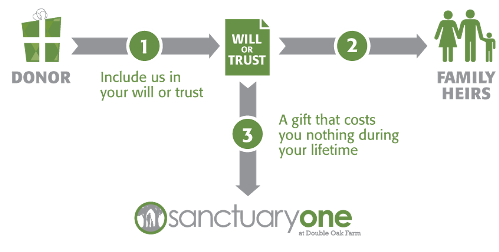
You can’t take it with you, but you can make an impact on the lives of hundreds of animals and visitors with a planned gift to Sanctuary One. There are a variety of ways you can leave a legacy, without any monetary commitment today.
Bequests
Bequests, or gifts in your will, are what most people think of when they hear about planned giving. A bequest is easy to arrange, will not alter your current lifestyle in any way, and can be easily modified to address your changing needs.
Sample Text For Your Will
I give and devise to Sanctuary One, tax ID #20-8982518, located in Jacksonville, OR, the sum of $___________ to be used for its general support.
Gifts Through Life Insurance
If you have a life insurance policy, you can name Sanctuary One as the beneficiary or co-beneficiary of your policy. Your insurance agent can help you with the paperwork.
Retirement Accounts
Like a life insurance policy, Sanctuary One can be named as the beneficiary or co-beneficiary of your account. Heirs other than a spouse pay significant income taxes on inherited retirement accounts. Making a gift to Sanctuary One from your retirement accounts can help limit these taxes. Request a “change of beneficiary form” from your retirement account administrator to get started.
Gifts of Real Estate or Personal Property
You can deed your home(s), undeveloped property, or a commercial building to Sanctuary One. Include personal items such as automobiles, antiques, artwork, jewelry, and other treasures in your estate plan. Valuable items such as these can be bequeathed to a worthy charity like Sanctuary One.
Charitable Remainder Trusts and Charitable Gift Annuities
A charitable remainder trust or a charitable gift annuity is an arrangement in which a donor’s assets provide a regular income stream to the donor, until that income is no longer needed. The assets of the trust or annuity are then passed on to a charity like Sanctuary One.
Charitable Lead Trusts
A charitable lead trust is designed to reduce the beneficiaries’ taxable income by first donating a portion of the trust’s income to a charity like Sanctuary One. After a specified period of time the remainder of the trust goes to the beneficiaries. The concept is to reduce taxes upon the estate left by the deceased by donating to charities from the estate until the taxes are reduced. Once that is accomplished the estate is then transferred back to the beneficiaries.
FAQs
» Do I have to be wealthy to leave a legacy?
Almost anyone can make a charitable gift through estate planning. Most people have assets of some kind, even if they are not wealthy. If you have possessions, you have an estate. Planned giving is an opportunity make a greater impact in the long term than you may have thought possible or been capable of during your lifetime.
» Is it important to designate my instructions in a written will?
Your wishes for your estate must be recorded in a will to ensure that they will be carried out properly. Neither the government nor your family will be able to carry out your wishes without proper, legally binding written instructions.
» Don’t I want my heirs to benefit from my estate?
Many people want to use their estate to provide for their loved ones. Planned giving is a way to ensure that your heirs fully benefit from the resources you’ve built over a lifetime. Estate and capital gains taxes can significantly reduce the total amount of an inheritance. Making a charitable gift through your estate can decrease the taxes paid by your estate.
» Should I tell Sanctuary One about my estate plans?
Please do tell us if you intend to include Sanctuary One in your estate plans. We want to be able to thank you and, if you wish, to publicly acknowledge your gift and invite you to take a VIP tour of the Sanctuary. Click here for a Statement of Intent that you can fill out to inform us of your commitment.
» Will you take care of my animal(s) after I pass away?
We offer a unique Safe Haven program that can ensure your pet(s) have a place to live when you pass away.
A gift to Sanctuary One in your will or trust can ensure that your pets receive the tender, loving care they deserve in the event of your death or medical incapacity. It will also help the Sanctuary rescue more abused, neglected, and abandoned animals. However, the Safe Haven program does require planning. Please contact our Executive Director for a no-commitment consultation, megan@sanctuaryone.org.